tattoos
Dynamic Glitter Text Generator at TextSpace.net
Showing posts with label Science. Show all posts

Friday, February 18, 2011

Baldness in Mice: Cured!

Baldness has been accidentally cured in mice!  Wait, there are bald mice?

Apparently a bunch of scientists were using super-stressed out bald mice to study the effects of stress on your gut by blocking a particular hormone.  I don't know if their ulcers went away, but the stressed mice grew all their hair back.  Check out details on the study here.

Not sure if it will lead to a baldness cure for humans (though I'm hoping!), but at least Mickey can stop wearing that stupid toupee.
But he'd still better pay Jimmy Conway his money.

Tuesday, November 23, 2010

Candy or Cocaine?

I'm Rat James, bitch!
Here's your SAT analogy test question for the day.
Males : Blow Pops :: Females : Blow
At least when it comes to rats.  Scientists have discovered that male rats prefer sweets to cocaine, while females went cuckoo for the Bolivian marching powder.  Read more about why scientists are getting rodents high in this article.

Saturday, July 4, 2009

shrinking sheep global warming

well here it is again another weird global warming story, this time shrinking sheep, it just gets dafter and dafter.

because on some scottish island scientists have decided that some sheep shrunk in sixe it must be the dreaded global warming again, and im thinking arnt sheep aloud to lose a bit of weight, maybe they have been on a diet!?.

Monday, September 8, 2008

Chapter 78.9: Photosynthesis, Anyone?

School's back in session. Earlier this summer, Stanford University released a report that found young students fare better when learning complex concepts using "everyday English."

As a case in point, researchers noted that students learning about photosynthesis need to understand a little bit of Latin, a dash of French, and some Greek. The problem, the researchers said, is that students are getting new words and new ideas at the same time. That can be difficult for children. Ok, they may be right. They're certainly right that a child can learn about an apple before they knew how to say "apple."

But what's so wrong with teaching a kid something difficult? As long as you have multiple ways of getting the point across — reinforcing the concepts — then a good teacher should be able to get the lesson across. I think that what they're doing is pointing out the obvious: a child won't learn a complex concept without being able to relate to it at a certain level.

Perhaps I'm not understanding what's so revolutionary. I'll read it again.

Friday, August 22, 2008

Chapter 78.6: My Kind of Fish Story

What's not to like in this fish story (except possibly fish)? Apparently a couple of enterprising young students were intrigued by a conversation around the dinner table. Their father, a scientist, was talking shop about bird DNA (and who doesn't?), when one of the teenage girls asked if genetic barcoding could be done on sushi. "Yeah, I think you could," he replied, "and if you did that, I think you’d be the first ones."

Sciencephobes take note: that's how ideas happen.

What the girls found out is that, in a small and admittedly limited sample, many of the seafood meals one may purchase in New York City are fishy to say the least. That is, they're mislabeled. Of course, being sensible and sufficiently conscious of the litigious society we live in, they refused to label the ne'er-do-wells where they bought the faux red snappers and white tuna (nothing said about blue fish; where's their American spirit?). But they did say kind things about one fish seller.

While I might have blogged about this story anyway, the thing that made me most proud of these kids is that they're not pursuing science in college. Don't get me wrong, there's a dearth of good young American scientists coming up through the ranks — especially female scientists — so I'd have been happy to see them pursue the subject. But this means there'll be more curious, scientifically adept kids studying art, studying literature, studying history, studying economics.

As the article concludes, the wheel maybe coming around full circle.
In a way, Dr. Ausubel said, their experiment is a return to an earlier era of scientific inquiry. "Three hundred years ago, science was less professionalized," he said, and contributions were made by interested amateurs. "Perhaps the wheel is turning again where more people can participate."

Let's hope so.

Tuesday, July 29, 2008

Monday, July 28, 2008

Chapter 78: Eureka! I've Found It!

I know I'm a little odd at times, but I have to admit I really enjoy a silly little show on the Sci Fi channel. Perhaps it's because of my family genetics, but I love Eureka, which is premiering its third season on Tuesday. From the infectious opening theme to the delightfully off-center characters in the town full of scientists and geniuses, I look forward to the whole thing. Even the new line of commercials that parody home shopping shows are clever. And I usually hate commercials that I've seen over and over again.

There are smarter shows out there, and it can be predictable, but there's something about this fictional town and the people that live there that make me happy. If you enjoyed Northern Exposure (one of my all time favorites) back in the early '90s, then I think you'll find a new home in Eureka.

Thursday, February 7, 2008

Chapter 72.7: God Speed, Columbus


Perhaps this isn't the most appropriate lead into a post, but I missed the actual fiftieth anniversary of NASA last week, so I'm doing it anyway. Today, Space Shuttle Atlantis launched successfully into space, carrying with it the Columbus lab built by the European Space Agency. If all goes right, it will dock with the International Space Station on Saturday.

I refuse to be spooked by the backstory of how this launch was supposed to occur in December but was delayed due to malfunctioning fuel-tank sensors, and how rainy weather almost scuttled the flight today. I prefer to think of how fitting that after fifty years of American dominance in space (ok, the Russians have certainly proven they are quite capable, but we got to the Moon), we are venturing forward in a much more global endeavor. There are many detractors out there who believe spending tax money to ship people into space is a waste, but I disagree. I'm all for looking toward the future and supporting work that is designed to make the future something worth reaching.

I like that governments -- as well as individuals -- support discovery, support adventure. Sure it can be risky, as the numerous deaths in our skies and closer to earth can attest to. In my eyes the tragedy isn't simply that these people died (of course, that's terrible), but that most Americans don't appreciate what these astronauts are striving to achieve and thus seem to die in vain. Such a comment begs the question: What are the astronauts trying to do? Obviously, the answer is different with each mission, but in a nutshell, they're trying to advance civilization, small step by small step.

I'm sure people could argue about how rockets and the satellites they carry can be automated, and high-placed officials with the right credentials argue about those very things and build informed trains of thought. But there's still something to be said for human adventure. And as it would have been tragic if other Europeans didn't follow Columbus to the newly discovered America, so too is it tragic if this Columbus is not followed by other laboratories, other astronauts, other human-based missions. To the Moon, Alice, and on to Mars. But not before we have an informed understanding of what is involved in getting there.

God Speed, Atlantis. Deliver Columbus to her destination. And come back safe. There's more to do in the future.

Wednesday, December 12, 2007

Chapter 70.75: Oh, the Deep Places You Will Go


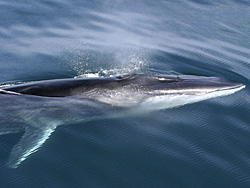
I was fascinated by an article in Tuesday's Science Times about the eating habits of baleen whales. Apparently, a group of marine biologists were studying several baleen whales and trying to record the latest hit Fin Whale Song. But the whales they found weren't singing, they were hungry.

Their study may have been considered wasted time except another biologist recognized that this was the first analyzable data of these whales feeding. It turns out that most of the suppositions about how these giants feed were all wrong. What they do is launch themselves hundreds of feet down into schools of krill -- tiny shrimplike creatures that are the favorite meal of fin whales -- but as they approach, they open their large mouth, which acts like a parachute to slow the whale down. This massive creature can stop on a dime -- well, it takes three seconds, which is mighty fast when you're talking about an 80-ton finback; your train doesn't do that. This is pretty interesting stuff to a whale geek like me.

I might have let it go at that, but then I received an email from one of my brothers noting the excellent crossword puzzle word that the article included: "rorqual," which is a group of baleen whales that includes the fin whale, the Minke whale, the humpback, and the blue whale. I went to Wikipedia to learn a little more about rorquals and discovered that there's another type of whale in there that I'd never heard of. It's called Balaenoptera omurai and it was only discovered four years ago in waters outside Japan. Whether it's a distinct species has yet to be determined, but it resembles a fin whale, only smaller. According to the wikipedia entry, it's likely to be called Omura's Whale, after the Japanese cetologist who discovered it.

To me, this little experience is a perfect example of how newspapers, simple curiosity, and the Internet blend to educate the world. Pretty deep stuff.

Friday, July 6, 2007

Chapter 63.7: Time! Gentlemen, Please


While walking from the train to the PATH this morning, I saw a guy with a t-shirt that said "Time is an invention." Brilliant.

Because it's true. Define time. What is it? It's a measurement, but of what? It's a construction we use to measure our past and our future. And time can be changed. Calendars are not static. We pick up a day every four years, a leap second every couple of years, because time as we define it is imperfect. Time is a human construct; God is timeless.

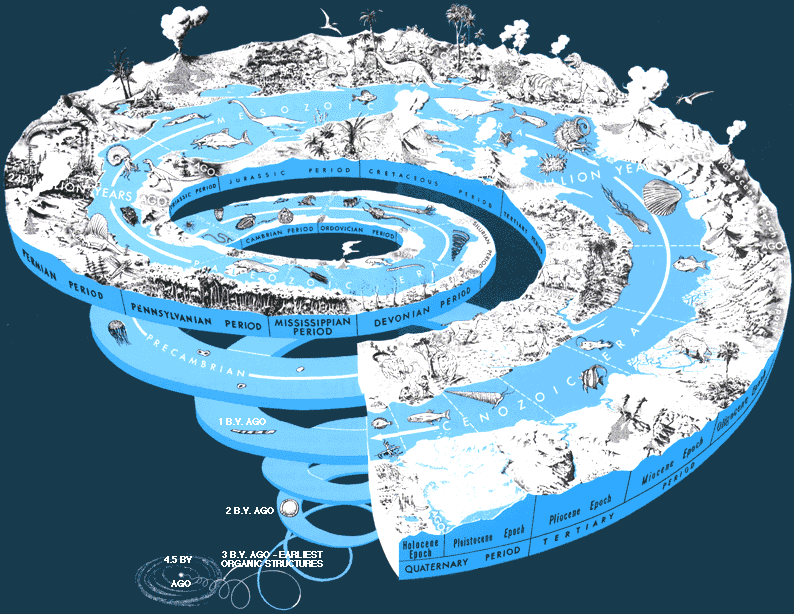
I mention God quite purposely, because there are wackos among us who believe that the earth has only existed for a few thousand years, not the hundreds of millions of years that science has proven. Many of these same wackos decry evolution calling it "just a theory." Time is a theory, too, but they don't seem to see it. Theory ... think about that word. What do you see in it? I see God, therein.

Thursday, July 5, 2007

Chapter 63.55: Truthiness vs. Science

I also noticed an even more fascinating opinion piece in the L.A. Times today. This one deals with science versus gut instinct, and includes an examination of what noted wordsmith Stephen Colbert calls "truthiness." As someone who prefers scientific proof to gut instinct, I hesitate to say I think you'll like what it says, but I did.

Friday, June 15, 2007

Chapter 62: Destination Mars


Ever wonder what the planet Mars might have looked like eons ago, when it might have sported water and oceans? Scientists at Cal Berkeley have come up with the image I've posted above. Take a look at what they say about the likelihood that Mars once was covered with water. Interesting stuff for "spaceophiles" like me.

Tuesday, May 15, 2007

Chapter 60.7: The 300; New Liberal Arts

Ok, this will be a disjointed post because I seem to be citing a recent movie (that I haven't seen) and combining it with a phrase that in that context makes no sense. So let me explain: this is my 300th post since starting this blog in 2004. More than some people, a lot few than many others. Self-congratulation is now over.

As for "the new liberal arts," that comes from an interesting post I saw at MIT Online, a publication at the Massachusetts Institute of Technology. The writer, who is from the university's class of 2007, discusses social entrepreneurism and the importance of the priveleged to give something back to sociey -- not simply make buckets of money. And he recounts an alumnus who told him "Engineering is the liberal arts of the 21st century."

What an interesting comment; it might even be true. I'm becoming more and more convinced that the state of education -- particularly math and science -- is at a dangerous low in this country. I've spoken with people from Microsoft and the former governor of a major manufacturing state as well as others who have similar concerns, and they believe that American students -- and their parents -- have no idea how poor their math and science skills are.

The liberal arts comment points to how broadly necessary those skills are and will become. Technology is at the heart of nearly everything we use today -- this computer I'm typing on, the cash register at the coffee shop where you bought your cup this morning, the blinking voice mail like reminding your co-worker that she's ignoring a client -- and our future is spending it on their hand-held game or their cell phone, oblivious to irony.

We are far from a tipping point, unless it's already tipped to the negative. Getting through to the kids will not be easy. And it's entirely possible they don't care and will blame us for letting their world fall apart. It's not enough that we've taught them to read; we need to help them learn how to think. That requires math and science as certainly as it requires art and literature.

Sunday, March 11, 2007

Chapter 58.314159: Good Math

Recently, the Seattle Post-Intelligencer posted a commentary calling for a commitment to emphasizing math in the schools. This call is certainly necessary, and long overdue. However, my pessimism may be getting the better of me. I'm not sure we can expect much. As the commentary states, we need better professional development of teachers, with a goal of training them to be more confident in their role. This takes time. No time like the present to start, but I think what we need to do is get math into more subjects; find where math fits into the history class, perhaps. Or make the examples in math class more accessible to kids: you have 500 songs on your iPod, what percentage of the memory is still available for more songs?

I'm not convinced the math block for many students is due to the subject matter. I think a big part of the problem is that math isn't cool. Maybe each student can have a team in a free fantasy league; each kid must keep their team under a salary cap. Work the numbers.

Easy for me to say -- I'm not teaching. Students who are bored are potentially disruptive, and one of the major challenges for education is classroom management. It takes more than teachers who are confident in their abilities to teach math, it takes teachers who are enthusiastic about teaching -- period. That involves a strong educational environment, a supportive administration, etc.

I'm all for emphasizing math, and I agree with Seattle -- home of the Bill & Melinda Gates Foundation -- being at the vanguard of a movement. But this will be a long slog, and the kids will need to see the light at the end of the tunnel. Kids don't implicitly care that the United States' position as an economic leader is imperiled without better math, science, and engineering education. They want to know what it means to them. Once that's been solved, you'll find more eager children.

Tuesday, February 27, 2007

Chapter 57.1: Making Assumptions

The story is all over the place: ossuaries found nearly a quarter-century ago contained the bones of Jesus of Nazareth, his wife Mary Magdalene, and a son, Judah. The assertion is obviously offensive to Christians, who believe that Jesus not only resurrected from his death on the cross but was bodily assumed into heaven. In other words -- no bones. The other question about whether he was married is also a point of contention, but in my mind is not as significant a matter of faith as whether or not he assumed into heaven.

I'll have to brush up on my Revelations and probably Acts and other books of the New Testament, but the debate makes me curious whether these are the types of things that are predicted to occur before the second coming. Are Christians going to be stuck doubting their faith and only those who are deemed true believers judged worthy of the Kingdom of God? I don't remember the biblical descriptions with certitude. But I will say this: only people who have no concept of probability will believe unequivocally that this is THE Jesus and Mary. This is an argument for people who demand proof but can't be assured of recognizing it when they see it.

Another point I've not seen argued in this situation is the significance of Mary Magdalene's bones being in the Palestine region. Baigent and Lincoln, the guys who took the Holy Blood, Holy Grail argument to the public in the '80s and whose ideas were part of the genesis for Dan Brown's DaVinci Code, claim that their research points to Mary fleeing Palestine and coming to the shores of what is now southern France with her daughter, who passes on the bloodline. So if Mary Magdalene escaped to France, who's this woman that was in the ossuary?

I may fashion myself an intelligent man, but I'll admit that I take my religious belief as a matter of faith. I'll accept some things that might not make sense scientifically. Do I suspect that Mary Magdalene and Jesus were married? Yes. If what I've been taught about Jews in that time is accurate, it would have been odd if a man of his age weren't married with children. These things don't bother me in the slightest. To me, it makes his willingness to die for our sins more compelling, actually. It also makes his moment of doubt in the Garden of Gesthemene more realistic. He had a life that he was giving up, not just a growing group of believers. Mohandas Gandhi was married too, but it doesn't make his sacrifices for his people less noble. Of course, one significant difference is that Gandhi was not the progenitor of a religious belief system. That's a debate for another time.

My point is to say that while it's intellectually stimulating to see this issue of the ossuaries come into the public realm, I'll still be going to mass to celebrate a faith I share with millions of other people. Amen.
 

blogger templates | Blogger