


A Christmas tree, Yule tree or Tannenbaum (German: fir tree) is one of the most popular traditions associated with the celebration of Christmas. It is normally an evergreen coniferous tree that is brought into a home or used in the open, and is decorated with Christmas lights and colorful ornaments during the days around Christmas. An angel or star is often placed at the top of the tree, representing the host of angels or the Star of Bethlehem from the Nativity story.
The modern custom of erecting a Christmas tree can be traced to 16th century Germany, though neither an inventor nor a single town can be identified as the sole origin for the tradition, which was a popular merging of older traditions mentioned above; in the Cathedral of Strasbourg in 1539, the church record mentions the erection of a Christmas tree. In that period, the guilds started erecting Christmas trees in front of their guildhalls: Ingeborg Weber-Kellermann (Marburg professor of European ethnology) found a Bremen guild chronicle of 1570 which reports how a small fir was decorated with apples, nuts, dates, pretzels and paper flowers, and erected in the guild-house, for the benefit of the guild members' children, who collected the dainties on Christmas day.[6] Another early reference is from Basel, where the tailor apprentices carried around town a tree decorated with apples and cheese in 1597. During the 17th century, the custom entered family homes. One Strasbourg priest, Johann Konrad Dannerstuart, complains about the custom as distracting from the Word of God.

By the early 18th century, the custom had become common in towns of the upper Rhineland, but it had not yet spread to rural areas. Wax candles are attested from the late 18th century. The Christmas tree remained confined to the upper Rhineland for a relatively long time. It was regarded as a Protestant custom by the Catholic majority along the lower Rhine and was spread there only by Prussian officials who were moved there in the wake of the Congress of Vienna in 1815.
In the early 19th century, the custom became popular among the nobility and spread to royal courts as far as Russia. Princess Henrietta of Nassau-Weilburg introduced the Christmas tree to Vienna in 1816, and the custom spread across Austria in the following years. In France, the first Christmas tree was introduced in 1840 by the duchesse d'Orléans.
The Queen's Christmas tree at Osborne House. The engraving republished in Godey's Lady's Book, Philadelphia, December 1850
The Queen's Christmas tree at Osborne House. The engraving republished in Godey's Lady's Book, Philadelphia, December 1850
In Britain, the Christmas tree was introduced in the time of the personal union with Hanover, by George III's Queen Charlotte of Mecklenburg-Strelitz but the custom did not spread much beyond the royal family. Queen Victoria as a child was familiar with the custom. In her journal for Christmas Eve 1832, the delighted 13-year-old princess wrote, "After dinner...we then went into the drawing-room near the dining-room...There were two large round tables on which were placed two trees hung with lights and sugar ornaments. All the presents being placed round the trees...". After her marriage to her German cousin, Prince Albert, the custom became even more widespread. In 1847, Prince Albert wrote: "I must now seek in the children an echo of what Ernest [his brother] and I were in the old time, of what we felt and thought; and their delight in the Christmas-trees is not less than ours used to be". A woodcut of the royal family with their Christmas tree at Osborne House, initially published in the Illustrated London News of December 1848, was copied in the United States at Christmas 1850 (illustration, left). Such patriotic prints of the British royal family at Christmas celebrations helped popularise the Christmas tree in Britain and among the Anglophile American upper class.
Several cities in the United States with German connections lay claim to that country's first Christmas tree: Windsor Locks, Connecticut, claims that a Hessian soldier put up a Christmas tree in 1777 while imprisoned at the Noden-Reed House, while the "First Christmas Tree in America" is also claimed by Easton, Pennsylvania, where German settlers purportedly erected a Christmas tree in 1816. In his diary, Matthew Zahm of Lancaster, Pennsylvania, recorded the use of a Christmas tree in 1821 -- leading Lancaster to also lay claim to the first Christmas tree in America.Other accounts credit Charles Follen, a German immigrant to Boston, for being the first to introduce to America the custom of decorating a Christmas tree.[August Imgard, a German immigrant living in Wooster, Ohio, is the first to popularise the practice of decorating a tree with candy canes. In 1847, Imgard cut a blue spruce tree from a woods outside town, had the Wooster village tinsmith construct a star, and placed the tree in his house, decorating it with paper ornaments and candy canes. The National Confectioners' Association officially recognises Imgard as the first ever to put candy canes on a Christmas tree; the canes were all-white, with no red stripes. Imgard is buried in the Wooster Cemetery, and every year, a large pine tree above his grave is lit with Christmas lights.
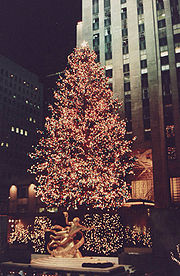
Many cities, towns, and department stores put up public Christmas trees outdoors, such as the Rich's Great Tree in Atlanta, the Rockefeller Center Christmas Tree in New York City and the large Christmas tree at Victoria Square in Adelaide. During most of the 1970s and 1980s, the largest Christmas tree in the world was put up every year on the property of The National Enquirer in Lantana, Florida. This tradition grew into one of the most spectacular and celebrated events in the history of southern Florida, but was discontinued on the death of the paper's founder in the late 1980s.
In some cities Festival of Trees are organised around the decoration and display of multiple trees as charity events. In some cases the trees represent special commemorative gifts, such as in Trafalgar Square in London, where the City of Oslo, Norway presents a tree to the people of London as a token of appreciation for the British support of Norwegian resistance during the Second World War; in Boston, where the tree is a gift from the province of Nova Scotia, in thanks for rapid deployment of supplies and rescuers to the 1917 ammunition ship explosion that leveled the city of Halifax; and in Newcastle upon Tyne, where the 15m-tall main civic Christmas tree is an annual gift from the city of Bergen, Norway, in thanks for the part played by soldiers from Newcastle in liberating Bergen from Nazi occupation.
The United States' National Christmas Tree is lit each year on the South Lawn of the White House. Today, the lighting of the National Christmas Tree is part of what has become a major holiday event at the White House. President Jimmy Carter lit only the crowning star atop the Tree in 1979 in honour of the Americans being held hostage in Iran; in 1980, the tree was fully lit for only 417 seconds, one second for each day the hostages had been in captivity.
The term Charlie Brown Christmas tree is used in the USA and Canada to describe any sad-looking, malformed little tree. Some tree buyers intentionally adopt such trees, feeling sympathetic to their plights. The term comes from the appearance of Charlie Brown's Christmas tree in the TV special A Charlie Brown Christmas.
In New Zealand, Pōhutukawa trees are described as "natural Christmas trees", as they bloom at Christmas time, and look like Christmas trees with their red flowers and green foliage.
Dates
Both setting up and taking down a Christmas tree are done on specific dates. In Europe, when the practice of setting up evergreen trees originated in pagan times, the practice was associated with the Winter Solstice, around December 21.[10] Tree decoration was later adopted into Christian practice after the Church set December 25 as the birth of Christ, thereby supplanting the pagan celebration of the solstice.
Traditionally, Christmas trees were not brought in and decorated until Christmas Eve (24 December), and then removed the day after twelfth night (6 January); to have a tree up before or after these dates was even considered bad luck. Modern commercialisation of Christmas has resulted in trees being put up much earlier; in shops often as early as late October (in the UK, Selfridge's Christmas department is up by early September, complete with Christmas trees). Some households in the U.S. do not put up the tree until the second week of December, and leave it up until the 6th of January (Epiphany). In Germany, traditionally the tree is put up on the 24th of December and taken down on the 7th of January, though many start one or two weeks earlier, and in Roman-Catholic areas the tree may be kept until late January. In Australia, the Christmas tree is usually put up on the 1st of December, which occurs about a week before the school summer holidays; except for South Australia, where most people put up their tree after the Adelaide Credit Union Christmas Pageant, which is in early November. Some traditions suggest that Christmas trees may be kept up until no later than the 2nd of February, the feast of the Presentation of Jesus in the Temple (Candlemas), when the Christmas season effectively closes.Superstitions say it's a bad sign if Christmas greenery is not removed by Candlemas Eve.
Types of trees used
Both natural and artificial trees are used as Christmas trees.
Natural trees
The most commonly used species are fir (Abies), which have the benefit of not shedding their needles when they dry out, as well as retaining good foliage colour and scent; but species in other genera are also used.
In northern Europe most commonly used are:
* Silver Fir Abies alba (the original species)
* Nordmann Fir Abies nordmanniana (as in the photo)
* Noble Fir Abies procera
* Norway Spruce Picea abies (generally the cheapest)
* Serbian Spruce Picea omorika
* Scots Pine Pinus sylvestris
* Stone Pine Pinus pinea (as small table-top trees)
* Swiss Pine Pinus cembra
In North America, Central America and South America most commonly used are:
* Balsam Fir Abies balsamea
* Fraser Fir Abies fraseri
* Grand Fir Abies grandis
* Guatemalan Fir Abies guatemalensis
* Noble Fir Abies procera
* Red Fir Abies magnifica
* Coast Douglas-fir Pseudotsuga menziesii
* Jeffrey Pine Pinus jeffreyi
* Scots Pine Pinus sylvestris
* Stone Pine Pinus pinea (as small table-top trees)
* Norfolk Island pine Araucaria heterophylla
Several other species are used to a lesser extent. Less-traditional conifers are sometimes used, such as Giant Sequoia, Leyland Cypress, Monterey Cypress and Eastern Juniper. Various types of spruce tree are also used for Christmas trees; but spruces (unlike firs) begin to lose their needles rapidly upon being cut, and many spruces, such as Blue Spruce have very sharp needles, making decorating uncomfortable. Virginia Pine is still available on some tree farms in the southeastern United States, however its winter colour is faded. The long-needled Eastern White Pine is also used there, though it is an unpopular Christmas tree in most parts of the country, owing also to its faded winter coloration and limp branches, making decorating difficult with all but the lightest ornaments. Norfolk Island pine is sometimes used, particularly in Oceania, and in Australia some species of the genera Casuarina and Allocasuarina are also occasionally used as Christmas trees. Hemlock species are generally considered unsuitable as Christmas trees due to their poor needle retention and inability to support the weight of lights and ornaments.
Some trees are sold live with roots and soil, often from a nursery, to be planted later outdoors and enjoyed (and often decorated) for years or decades. However, the combination of root loss on digging, and the indoor environment of high temperature and low humidity is very detrimental to the tree's health, and the survival rate of these trees is low. These trees must be kept inside only for a few days, as the warmth will bring them out of dormancy, leaving them little protection when put back outside into the midwinter cold in most areas. Others are produced in a container and sometimes as topiary for a porch or patio.
European tradition prefers the open aspect of naturally-grown, unsheared trees, while in North America (outside western areas where trees are often wild-harvested on public lands) there is a preference for close-sheared trees with denser foliage, but less space to hang decorations. The shearing also damages the highly attractive natural symmetry of unsheared trees.
In the past, Christmas trees were often harvested from wild forests, but now almost all are commercially grown on tree farms. Almost all Christmas trees in the United States are grown on Christmas tree farms where they are cut after about ten years of growth and new trees planted. According to the United States Department of Agriculture (USDA) agriculture census for 2002 (the census is done every five years) there were 21,904 farms were producing conifers for the cut Christmas tree market in America, 180,897 hectares (447,006 acres) were planted in Christmas trees, and 13,849 farms harvested cut trees. The top 5 percent of the farms (40 hectares / 100 acres or more) sold 61 percent of the trees. The top 26 percent of the farms (8 hectares / 20 acres or more) sold 84 percent of the trees. Farms less than 0.8 hectare (two acres) comprised 21 percent of the farms, and sold an average of 115 trees per farm.
In the UK, the British Christmas Tree Growers Association represents the interests of all those who grow Christmas trees in Great Britain and Northern Ireland.
The lifecycle of a Christmas tree from the seed to a 2-metre (7 ft) tree takes, depending on species and treatment in cultivation, between 8 and 12 years. First, the seed is extracted from cones harvested from older trees. These seeds are then usually grown in nurseries and then sold to Christmas tree farms at an age of 3-4 years. The remaining development of the tree greatly depends on the climate, soil quality, as well as the cultivation and tendance by the Christmas tree farmer
Artificial trees have become increasingly popular, as they are considered more convenient, cleaner, and (if used for several years) less expensive than real trees, as well as less wasteful than cutting down real trees. Trees come in a number of colours and "species", and some come pre-decorated with lights. At the end of the Christmas season artificial trees can be disassembled and stored compactly.
Artificial trees are sometimes even a necessity in some rented homes (especially apartment flats), due to the potential fire danger from a dried-out real tree, leading to their prohibition by some landlords. They may also be necessary for people who have an allergy to conifers, and are popular in office settings.
Feather trees
The first artificial trees were tabletop feather trees, made from green-dyed goose feathers wound onto sticks drilled into a larger one, like the branches on a tree. Originating in Germany in the 19th century to prevent further deforestation, these "minimalist" trees show off small ornaments very well. The first feather trees came to the U.S. in 1913, in the Sears, Roebuck and Company catalog.
Plastic trees
The first modern artificial Christmas trees were produced by companies which made brushes. They were made the same way, using animal hair (mainly pig bristles) and later plastic bristles, dyed pine-green in colour, inserted between twisted wires that form the branches. The bases of the branches were then twisted together to form a large branch, which was then inserted by the user into a wooden pole (now metal with plastic rings) for a trunk. Each row of branches is a different size, colour-coded at the base with paint or stickers for ease of assembly.
The first trees looked like long-needled pine trees, but later trees use flat PVC sheets to make the needles. Many also have very short brown "needles" wound in with the longer green ones, to imitate the branch itself or the bases that each group of pine (but not other conifer) needles grows from. These trees have become a little more realistic every year, with a few deluxe trees containing multiple branch styles and newly developed True Needle technology to more closely imitate nature. Many trees now come in "slim" versions, to fit in smaller spaces. Most of the better trees have branches hinged to the pole, though the less-expensive ones generally still come separately. The hinged branched trees just need for the branches to be lowered, but they are a little less compact. Better trees also have more branch tips, the number usually listed on the box.
Around 2003, some trees with moulded plastic branches started selling in the U.S. Now there are also upside down Christmas trees after a designer at Roman Inc. put one in their showroom to help show off their new line[16]. Purchasers from all the major stores kept asking how much the tree was, even though it was never intended for sale. These Christmas trees are advertised to "Give you more space for presents".
Designer trees
The first artificial trees that were not green were the metallic trees, introduced about 1958, and quite popular through the 1960s. These were made of aluminium attached to metal rods, supported on wooden or aluminium central poles. Some were made with aluminium-coated paper, which was inflammable. These posed a great fire hazard if lights were put directly on them, particularly the relatively hot bulbs sold in that era; warnings to this effect are still issued with some Christmas tree lights. They were instead lit by a spotlight or floodlight, often with a motorised rotating colour wheel in front of it.
More recent tinsel trees can be used safely with lights, due to the use of flame retardant materials as well as improvements in the safety of the Christmas tree lights themselves.
Other artificial trees may look nothing like a conifer except for the triangular or conical shape. These may be made from cardboard, glass, plastic, or from stacked items such as ornaments. Such items are often used as tabletop decorations.
Outdoor trees
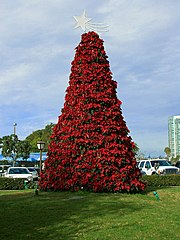
Outdoor branched trees made out of heavy white-enameled steel wires have become more popular on U.S. lawns in the 2000s, along with 1990s spiral ones that hang from a central pole, both styles being lighted with standard miniature lights. These lights are usually white, but often are green, red, red/green, blue/white, blue, or multicoloured, and sometimes with a small controller to fade colours back and forth.
A few hotels and other buildings, both public and private, will string lights up from the roof to the top of a small tower on top of the building, so that at night it appears as a lit Christmas tree, often using green or other coloured lights. Some skyscrapers will tell certain offices to leave their lights on (and others off) at night during December, creating a Christmas tree pattern.
Other gimmicks
Since the late 1990s, many indoor artificial trees come pre-strung with lights. Some are instead lit partly or completely by fibre optics, with the light in the base, and a rotating colour wheel causing various colours to shimmer across the tree.
In 2005 Upside-Down Christmas Trees became popular. They were originally sold as decorations for merchants that allowed customers to get closer to ornaments being sold. Customers then wanted to replicate the inverted tree. Retailers also claimed that the trees were popular because they allowed larger presents to be placed beneath the trees. Upside-down Christmas trees come in three varieties: stand-alone, ceiling, and wall. The stand-alone trees have a flat base. Ceiling trees have a base that can be bolted into a ceiling, and wall trees are generally half of a tree, that are bolted to a wall.
Past gimmicks include small talking or singing trees, and trees which blow "snow" (actually small styrofoam beads) over themselves, collecting them in a decorative cardboard bin at the bottom and blowing them back up to the top through a tube hidden next to the trunk.
A long-standing and simple gimmick is conifer seedlings sold with cheap decorations attached by soft pipe cleaners. Real potted ones are often sold like this, and artificial ones often come with a "root ball" but only sometimes with decorations.
Environmental issues
There is some debate as to whether artificial or real trees are better for the natural environment. Artificial trees are usually made out of non-biodegradable PVC, polyethylene, or a combination of the two. Some trees have a warning that dust or leaves from the tree should not be eaten or inhaled. A small amount of real-tree material is used in some artificial trees. For instance, the bark of a real tree can be used to surface an artificial trunk.
Artificial trees can be used for many years, but are usually non-recyclable, ending up in landfills. Real trees are used only for a short time, but can be recycled and used as mulch or used to prevent erosion. Real trees also help reduce the amount of carbon dioxide in the atmosphere while growing.
Live trees are typically grown as a crop and replanted in rotation after cutting, often providing suitable habitat for wildlife. In some cases management of Christmas tree crops can result in poor habitat since it involves heavy input of pesticides. Organically grown Christmas trees are available in some markets, and as with many other crops, are widely held to be better for the environment.
Source: wikimedia
In the early 19th century, the custom became popular among the nobility and spread to royal courts as far as Russia. Princess Henrietta of Nassau-Weilburg introduced the Christmas tree to Vienna in 1816, and the custom spread across Austria in the following years. In France, the first Christmas tree was introduced in 1840 by the duchesse d'Orléans.
The Queen's Christmas tree at Osborne House. The engraving republished in Godey's Lady's Book, Philadelphia, December 1850
The Queen's Christmas tree at Osborne House. The engraving republished in Godey's Lady's Book, Philadelphia, December 1850
In Britain, the Christmas tree was introduced in the time of the personal union with Hanover, by George III's Queen Charlotte of Mecklenburg-Strelitz but the custom did not spread much beyond the royal family. Queen Victoria as a child was familiar with the custom. In her journal for Christmas Eve 1832, the delighted 13-year-old princess wrote, "After dinner...we then went into the drawing-room near the dining-room...There were two large round tables on which were placed two trees hung with lights and sugar ornaments. All the presents being placed round the trees...". After her marriage to her German cousin, Prince Albert, the custom became even more widespread. In 1847, Prince Albert wrote: "I must now seek in the children an echo of what Ernest [his brother] and I were in the old time, of what we felt and thought; and their delight in the Christmas-trees is not less than ours used to be". A woodcut of the royal family with their Christmas tree at Osborne House, initially published in the Illustrated London News of December 1848, was copied in the United States at Christmas 1850 (illustration, left). Such patriotic prints of the British royal family at Christmas celebrations helped popularise the Christmas tree in Britain and among the Anglophile American upper class.
Several cities in the United States with German connections lay claim to that country's first Christmas tree: Windsor Locks, Connecticut, claims that a Hessian soldier put up a Christmas tree in 1777 while imprisoned at the Noden-Reed House, while the "First Christmas Tree in America" is also claimed by Easton, Pennsylvania, where German settlers purportedly erected a Christmas tree in 1816. In his diary, Matthew Zahm of Lancaster, Pennsylvania, recorded the use of a Christmas tree in 1821 -- leading Lancaster to also lay claim to the first Christmas tree in America.Other accounts credit Charles Follen, a German immigrant to Boston, for being the first to introduce to America the custom of decorating a Christmas tree.[August Imgard, a German immigrant living in Wooster, Ohio, is the first to popularise the practice of decorating a tree with candy canes. In 1847, Imgard cut a blue spruce tree from a woods outside town, had the Wooster village tinsmith construct a star, and placed the tree in his house, decorating it with paper ornaments and candy canes. The National Confectioners' Association officially recognises Imgard as the first ever to put candy canes on a Christmas tree; the canes were all-white, with no red stripes. Imgard is buried in the Wooster Cemetery, and every year, a large pine tree above his grave is lit with Christmas lights.
Many cities, towns, and department stores put up public Christmas trees outdoors, such as the Rich's Great Tree in Atlanta, the Rockefeller Center Christmas Tree in New York City and the large Christmas tree at Victoria Square in Adelaide. During most of the 1970s and 1980s, the largest Christmas tree in the world was put up every year on the property of The National Enquirer in Lantana, Florida. This tradition grew into one of the most spectacular and celebrated events in the history of southern Florida, but was discontinued on the death of the paper's founder in the late 1980s.
In some cities Festival of Trees are organised around the decoration and display of multiple trees as charity events. In some cases the trees represent special commemorative gifts, such as in Trafalgar Square in London, where the City of Oslo, Norway presents a tree to the people of London as a token of appreciation for the British support of Norwegian resistance during the Second World War; in Boston, where the tree is a gift from the province of Nova Scotia, in thanks for rapid deployment of supplies and rescuers to the 1917 ammunition ship explosion that leveled the city of Halifax; and in Newcastle upon Tyne, where the 15m-tall main civic Christmas tree is an annual gift from the city of Bergen, Norway, in thanks for the part played by soldiers from Newcastle in liberating Bergen from Nazi occupation.
The United States' National Christmas Tree is lit each year on the South Lawn of the White House. Today, the lighting of the National Christmas Tree is part of what has become a major holiday event at the White House. President Jimmy Carter lit only the crowning star atop the Tree in 1979 in honour of the Americans being held hostage in Iran; in 1980, the tree was fully lit for only 417 seconds, one second for each day the hostages had been in captivity.
The term Charlie Brown Christmas tree is used in the USA and Canada to describe any sad-looking, malformed little tree. Some tree buyers intentionally adopt such trees, feeling sympathetic to their plights. The term comes from the appearance of Charlie Brown's Christmas tree in the TV special A Charlie Brown Christmas.
In New Zealand, Pōhutukawa trees are described as "natural Christmas trees", as they bloom at Christmas time, and look like Christmas trees with their red flowers and green foliage.
Dates
Both setting up and taking down a Christmas tree are done on specific dates. In Europe, when the practice of setting up evergreen trees originated in pagan times, the practice was associated with the Winter Solstice, around December 21.[10] Tree decoration was later adopted into Christian practice after the Church set December 25 as the birth of Christ, thereby supplanting the pagan celebration of the solstice.
Traditionally, Christmas trees were not brought in and decorated until Christmas Eve (24 December), and then removed the day after twelfth night (6 January); to have a tree up before or after these dates was even considered bad luck. Modern commercialisation of Christmas has resulted in trees being put up much earlier; in shops often as early as late October (in the UK, Selfridge's Christmas department is up by early September, complete with Christmas trees). Some households in the U.S. do not put up the tree until the second week of December, and leave it up until the 6th of January (Epiphany). In Germany, traditionally the tree is put up on the 24th of December and taken down on the 7th of January, though many start one or two weeks earlier, and in Roman-Catholic areas the tree may be kept until late January. In Australia, the Christmas tree is usually put up on the 1st of December, which occurs about a week before the school summer holidays; except for South Australia, where most people put up their tree after the Adelaide Credit Union Christmas Pageant, which is in early November. Some traditions suggest that Christmas trees may be kept up until no later than the 2nd of February, the feast of the Presentation of Jesus in the Temple (Candlemas), when the Christmas season effectively closes.Superstitions say it's a bad sign if Christmas greenery is not removed by Candlemas Eve.
Types of trees used
Both natural and artificial trees are used as Christmas trees.
Natural trees
The most commonly used species are fir (Abies), which have the benefit of not shedding their needles when they dry out, as well as retaining good foliage colour and scent; but species in other genera are also used.
In northern Europe most commonly used are:
* Silver Fir Abies alba (the original species)
* Nordmann Fir Abies nordmanniana (as in the photo)
* Noble Fir Abies procera
* Norway Spruce Picea abies (generally the cheapest)
* Serbian Spruce Picea omorika
* Scots Pine Pinus sylvestris
* Stone Pine Pinus pinea (as small table-top trees)
* Swiss Pine Pinus cembra
In North America, Central America and South America most commonly used are:
* Balsam Fir Abies balsamea
* Fraser Fir Abies fraseri
* Grand Fir Abies grandis
* Guatemalan Fir Abies guatemalensis
* Noble Fir Abies procera
* Red Fir Abies magnifica
* Coast Douglas-fir Pseudotsuga menziesii
* Jeffrey Pine Pinus jeffreyi
* Scots Pine Pinus sylvestris
* Stone Pine Pinus pinea (as small table-top trees)
* Norfolk Island pine Araucaria heterophylla
Several other species are used to a lesser extent. Less-traditional conifers are sometimes used, such as Giant Sequoia, Leyland Cypress, Monterey Cypress and Eastern Juniper. Various types of spruce tree are also used for Christmas trees; but spruces (unlike firs) begin to lose their needles rapidly upon being cut, and many spruces, such as Blue Spruce have very sharp needles, making decorating uncomfortable. Virginia Pine is still available on some tree farms in the southeastern United States, however its winter colour is faded. The long-needled Eastern White Pine is also used there, though it is an unpopular Christmas tree in most parts of the country, owing also to its faded winter coloration and limp branches, making decorating difficult with all but the lightest ornaments. Norfolk Island pine is sometimes used, particularly in Oceania, and in Australia some species of the genera Casuarina and Allocasuarina are also occasionally used as Christmas trees. Hemlock species are generally considered unsuitable as Christmas trees due to their poor needle retention and inability to support the weight of lights and ornaments.
Some trees are sold live with roots and soil, often from a nursery, to be planted later outdoors and enjoyed (and often decorated) for years or decades. However, the combination of root loss on digging, and the indoor environment of high temperature and low humidity is very detrimental to the tree's health, and the survival rate of these trees is low. These trees must be kept inside only for a few days, as the warmth will bring them out of dormancy, leaving them little protection when put back outside into the midwinter cold in most areas. Others are produced in a container and sometimes as topiary for a porch or patio.
European tradition prefers the open aspect of naturally-grown, unsheared trees, while in North America (outside western areas where trees are often wild-harvested on public lands) there is a preference for close-sheared trees with denser foliage, but less space to hang decorations. The shearing also damages the highly attractive natural symmetry of unsheared trees.
In the past, Christmas trees were often harvested from wild forests, but now almost all are commercially grown on tree farms. Almost all Christmas trees in the United States are grown on Christmas tree farms where they are cut after about ten years of growth and new trees planted. According to the United States Department of Agriculture (USDA) agriculture census for 2002 (the census is done every five years) there were 21,904 farms were producing conifers for the cut Christmas tree market in America, 180,897 hectares (447,006 acres) were planted in Christmas trees, and 13,849 farms harvested cut trees. The top 5 percent of the farms (40 hectares / 100 acres or more) sold 61 percent of the trees. The top 26 percent of the farms (8 hectares / 20 acres or more) sold 84 percent of the trees. Farms less than 0.8 hectare (two acres) comprised 21 percent of the farms, and sold an average of 115 trees per farm.
In the UK, the British Christmas Tree Growers Association represents the interests of all those who grow Christmas trees in Great Britain and Northern Ireland.
The lifecycle of a Christmas tree from the seed to a 2-metre (7 ft) tree takes, depending on species and treatment in cultivation, between 8 and 12 years. First, the seed is extracted from cones harvested from older trees. These seeds are then usually grown in nurseries and then sold to Christmas tree farms at an age of 3-4 years. The remaining development of the tree greatly depends on the climate, soil quality, as well as the cultivation and tendance by the Christmas tree farmer
Artificial trees have become increasingly popular, as they are considered more convenient, cleaner, and (if used for several years) less expensive than real trees, as well as less wasteful than cutting down real trees. Trees come in a number of colours and "species", and some come pre-decorated with lights. At the end of the Christmas season artificial trees can be disassembled and stored compactly.
Artificial trees are sometimes even a necessity in some rented homes (especially apartment flats), due to the potential fire danger from a dried-out real tree, leading to their prohibition by some landlords. They may also be necessary for people who have an allergy to conifers, and are popular in office settings.
Feather trees
The first artificial trees were tabletop feather trees, made from green-dyed goose feathers wound onto sticks drilled into a larger one, like the branches on a tree. Originating in Germany in the 19th century to prevent further deforestation, these "minimalist" trees show off small ornaments very well. The first feather trees came to the U.S. in 1913, in the Sears, Roebuck and Company catalog.
Plastic trees
The first modern artificial Christmas trees were produced by companies which made brushes. They were made the same way, using animal hair (mainly pig bristles) and later plastic bristles, dyed pine-green in colour, inserted between twisted wires that form the branches. The bases of the branches were then twisted together to form a large branch, which was then inserted by the user into a wooden pole (now metal with plastic rings) for a trunk. Each row of branches is a different size, colour-coded at the base with paint or stickers for ease of assembly.
The first trees looked like long-needled pine trees, but later trees use flat PVC sheets to make the needles. Many also have very short brown "needles" wound in with the longer green ones, to imitate the branch itself or the bases that each group of pine (but not other conifer) needles grows from. These trees have become a little more realistic every year, with a few deluxe trees containing multiple branch styles and newly developed True Needle technology to more closely imitate nature. Many trees now come in "slim" versions, to fit in smaller spaces. Most of the better trees have branches hinged to the pole, though the less-expensive ones generally still come separately. The hinged branched trees just need for the branches to be lowered, but they are a little less compact. Better trees also have more branch tips, the number usually listed on the box.
Around 2003, some trees with moulded plastic branches started selling in the U.S. Now there are also upside down Christmas trees after a designer at Roman Inc. put one in their showroom to help show off their new line[16]. Purchasers from all the major stores kept asking how much the tree was, even though it was never intended for sale. These Christmas trees are advertised to "Give you more space for presents".
Designer trees
The first artificial trees that were not green were the metallic trees, introduced about 1958, and quite popular through the 1960s. These were made of aluminium attached to metal rods, supported on wooden or aluminium central poles. Some were made with aluminium-coated paper, which was inflammable. These posed a great fire hazard if lights were put directly on them, particularly the relatively hot bulbs sold in that era; warnings to this effect are still issued with some Christmas tree lights. They were instead lit by a spotlight or floodlight, often with a motorised rotating colour wheel in front of it.
More recent tinsel trees can be used safely with lights, due to the use of flame retardant materials as well as improvements in the safety of the Christmas tree lights themselves.
Other artificial trees may look nothing like a conifer except for the triangular or conical shape. These may be made from cardboard, glass, plastic, or from stacked items such as ornaments. Such items are often used as tabletop decorations.
Outdoor trees
Outdoor branched trees made out of heavy white-enameled steel wires have become more popular on U.S. lawns in the 2000s, along with 1990s spiral ones that hang from a central pole, both styles being lighted with standard miniature lights. These lights are usually white, but often are green, red, red/green, blue/white, blue, or multicoloured, and sometimes with a small controller to fade colours back and forth.
A few hotels and other buildings, both public and private, will string lights up from the roof to the top of a small tower on top of the building, so that at night it appears as a lit Christmas tree, often using green or other coloured lights. Some skyscrapers will tell certain offices to leave their lights on (and others off) at night during December, creating a Christmas tree pattern.
Other gimmicks
Since the late 1990s, many indoor artificial trees come pre-strung with lights. Some are instead lit partly or completely by fibre optics, with the light in the base, and a rotating colour wheel causing various colours to shimmer across the tree.
In 2005 Upside-Down Christmas Trees became popular. They were originally sold as decorations for merchants that allowed customers to get closer to ornaments being sold. Customers then wanted to replicate the inverted tree. Retailers also claimed that the trees were popular because they allowed larger presents to be placed beneath the trees. Upside-down Christmas trees come in three varieties: stand-alone, ceiling, and wall. The stand-alone trees have a flat base. Ceiling trees have a base that can be bolted into a ceiling, and wall trees are generally half of a tree, that are bolted to a wall.
Past gimmicks include small talking or singing trees, and trees which blow "snow" (actually small styrofoam beads) over themselves, collecting them in a decorative cardboard bin at the bottom and blowing them back up to the top through a tube hidden next to the trunk.
A long-standing and simple gimmick is conifer seedlings sold with cheap decorations attached by soft pipe cleaners. Real potted ones are often sold like this, and artificial ones often come with a "root ball" but only sometimes with decorations.
Environmental issues
There is some debate as to whether artificial or real trees are better for the natural environment. Artificial trees are usually made out of non-biodegradable PVC, polyethylene, or a combination of the two. Some trees have a warning that dust or leaves from the tree should not be eaten or inhaled. A small amount of real-tree material is used in some artificial trees. For instance, the bark of a real tree can be used to surface an artificial trunk.
Artificial trees can be used for many years, but are usually non-recyclable, ending up in landfills. Real trees are used only for a short time, but can be recycled and used as mulch or used to prevent erosion. Real trees also help reduce the amount of carbon dioxide in the atmosphere while growing.
Live trees are typically grown as a crop and replanted in rotation after cutting, often providing suitable habitat for wildlife. In some cases management of Christmas tree crops can result in poor habitat since it involves heavy input of pesticides. Organically grown Christmas trees are available in some markets, and as with many other crops, are widely held to be better for the environment.
Source: wikimedia




 Christmas Greetings
 Christmas Greetings
 Christmas Greetings
 Christmas Greetings
 Christmas Greetings
 Christmas Greetings
 Christmas Greetings
 Christmas Themed Wedding Pictures
 Christmas Themed Wedding Pictures
 Christmas Themed Wedding Pictures
 Christmas Themed Weddings Pictures
 Christmas Themed Weddings Pictures
 Christmas Themed Wedding Pictures
 Christmas Themed Wedding Pictures
 Christmas Themed Wedding Pictures


